Embedded Files
Type 7
Type 7
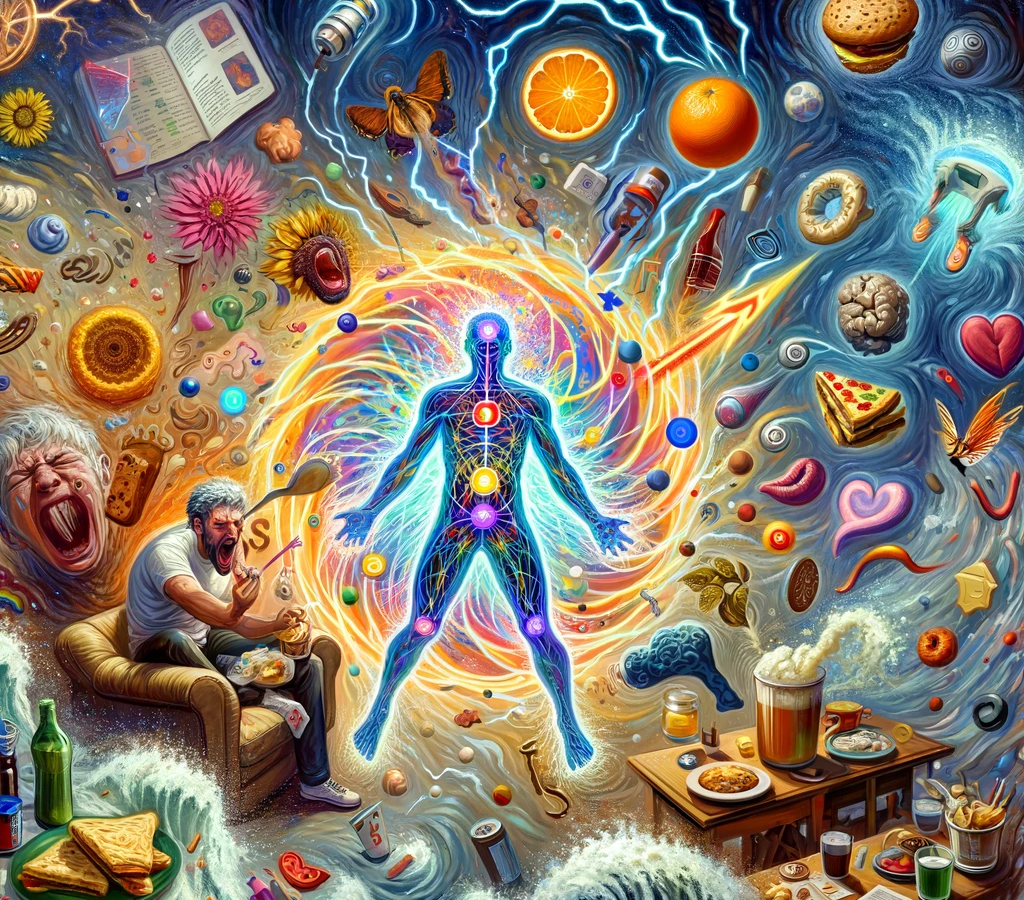
Enneagram Type 7 is associated with the pursuit of pleasure and adventure and with the avoidance of pain. Polyvagal Theory helps us read this type clearly. Type 7s show a strong activation of the sympathetic nervous system, the part of the autonomic nervous system that mobilises the body under stress and produces the 'fight or flight' reaction. This activation matches their need for constant stimulation and their fear of missing out: it drives them towards new experiences and away from negative emotions or situations that could bring discomfort.
Sympathetic Activation and Scarcity
Sympathetic Activation and Scarcity
For Type 7s, the core fear, the signal of unsafety, is scarcity: the fear of being deprived, or trapped in emotional pain. This scarcity is material, but also emotional and existential, and it leaves a persistent inner emptiness. In response, Type 7s increase their sympathetic activity and keep themselves in constant motion, searching for fulfilling experiences. This drive is an attempt to "fill themselves up" and so counter a deep fear of emptiness and lack.
Down the Polyvagal Ladder
Down the Polyvagal Ladder
As with Enneagram Type 2, Type 7s may move down the polyvagal ladder (the sequence of nervous system states, from safety and connection down to mobilisation and shutdown) into sympathetic activation when they sense possible scarcity or confinement. In this state their energy rises and their attention turns to external activities and acquisitions that keep emptiness and inadequacy at bay. The underlying belief, "I'm OK if I'm filling myself up, you're OK if you're filling me up," shows how much their inner fulfilment depends on external sources.
Gluttony as a Coping Mechanism
Gluttony as a Coping Mechanism
In Type 7s the strategy of gluttony goes beyond physical consumption: it becomes an insatiable appetite for experiences, knowledge and even spirituality. This overcompensation covers deep feelings of worthlessness and maintains an illusion of abundance and self-sufficiency. The fixation on planning, and the preference for what could be over what is, keeps them away from the present moment and from the reality of their inner emptiness.
Narcissism and Confusion
Narcissism and Confusion
To escape scarcity and emptiness, Type 7s may become attached to an inflated image of themselves, which can lead to narcissistic tendencies. Identifying with an image of abundance and self-worth disconnects them from their authentic self and blurs the line between imagination and reality. The fear of not being enough keeps the cycle of acquisition and achievement going, and sustains the trance of having to "fill up" at all costs.
Polyvagal Interpretation
Polyvagal Interpretation
From a polyvagal perspective, the task for Type 7s is to move up the ladder to a regulated state in which the ventral vagal system is engaged: the branch of the vagus nerve that supports safety, connection and a grounded presence in the moment. This means recognising and addressing the underlying fears and the scarcity mindset, cultivating inner sources of fulfilment, and developing practices of mindfulness and emotional regulation. In our practice we saw this shift in restless, hyperactive people long before Polyvagal Theory reached the general public: as their body settles, the search for stimulation slows down. The theory now points to the mechanism behind it. With this shift, Type 7s find abundance and contentment within themselves and depend less on external validation and on the compulsive need to escape discomfort.
Learn the method
Mesmeric Polyvagal Therapy is taught in the courses of Dr. Paret's School (ISI-CNV – Université Européenne): live seminars and online lessons, from the first-level Master to advanced training, with specific expertise in polyvagal hypnosis, trembling, completion of the response and ventral vagal stimulation. Request the programme and the next dates: our first contact is always a WhatsApp message, never a call.
→ Request information on the courses
→ Videos and international activity of Dr. Paret
→ marcoparet.com: the School of Dr. Paret
This site is available in: English · Italiano · Français · Русский · 中文
Research notes
A selection of peer-reviewed studies on polyvagal theory and vagal function that offer a scientific reading of the topics discussed in this article.
Robe A, Dobrean A, et al. (2019). Attention-deficit/hyperactivity disorder and task-related heart rate variability: a systematic review and meta-analysis. Neuroscience and Biobehavioral Reviews, 99, 11-22. Across 13 studies (869 people with ADHD, 909 controls), ADHD was associated with slightly lower vagally mediated HRV after task demands, with a small effect and high heterogeneity between studies. https://doi.org/10.1016/j.neubiorev.2019.01.022
Beauchaine TP (2015). Respiratory sinus arrhythmia: a transdiagnostic biomarker of emotion dysregulation and psychopathology. Current Opinion in Psychology, 3, 43-47. Beauchaine reviews evidence that low respiratory sinus arrhythmia and excessive vagal withdrawal under challenge are found across many forms of emotion dysregulation, including attention problems and hostility, and links them to prefrontal control. https://doi.org/10.1016/j.copsyc.2015.01.017
Thayer JF, Lane RD (2000). A model of neurovisceral integration in emotion regulation and dysregulation. Journal of Affective Disorders, 61(3), 201-216. The neurovisceral integration model links autonomic, attentional and affective systems and interprets excessive sympathetic activation as a failure of inhibitory control; it provides a physiological lens for stable patterns of emotional reactivity. https://doi.org/10.1016/s0165-0327(00)00338-4
Page updated
Google Sites
Report abuse
This site uses cookies from Google to deliver its services and to analyze traffic. Information about your use of this site is shared with Google. By using this site, you agree to its use of cookies.
Learn more
Got it