Embedded Files
Neuroendocrine Theory of Aging and the Benefits of Mesmeric Polyvagal Therapy
Why We Age (in Brief)
Why We Age (in Brief)
The Neuroendocrine Theory of Aging, proposed by the pioneers Vladimir Dilman and Ward Dean, holds that with age the body’s regulatory systems lose precision. The hypothalamus (the brain region that sets hormonal balance) shifts its set-points, the reference values it aims to maintain; hormone and neurotransmitter receptors become less sensitive; and the four major regulators (energy and metabolism, the HPA axis, that is the hypothalamus–pituitary–adrenal stress axis, reproduction, immunity) work with more “noise.” In practice this means more low-grade inflammation, longer stress responses and a reduced capacity to return quickly to calm. A core principle follows: restore the precision of feedback, with less chronic allostasis (the wear of constant adaptation to stress), more responsive receptors and shorter hormone peaks. This conceptual framework is consistent with our “state-first” aim: regulate the state of the nervous system first.
The Polyvagal Bridge: “State Before Story”
The Polyvagal Bridge: “State Before Story”
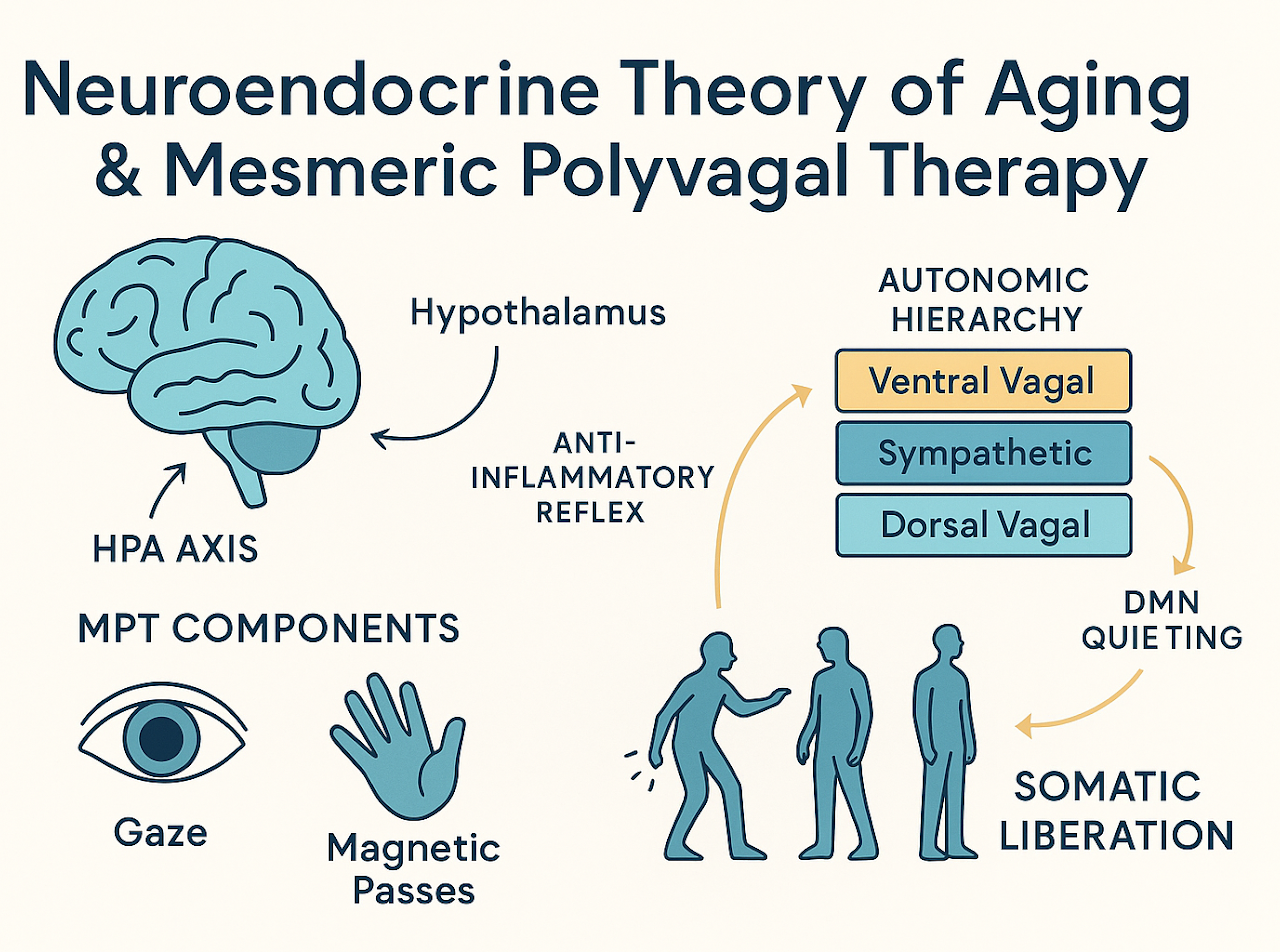
Polyvagal Theory (Stephen Porges) shows that our bodily states are organized in a hierarchy:
Ventral vagal (safety, social engagement): steadier breathing, a melodic voice (prosody), stable analgesia.
Sympathetic (fight or flight): mobilization.
Dorsal vagal (immobility, the body’s oldest defense): from rest to shutdown and collapse.
The key idea: when we establish safety through non-verbal signals of reliability, the body resets its autonomic set-points. The DMN (default mode network, the brain circuits of mental chatter) quiets, interoception (the perception of one’s inner body) becomes clearer, and cooperation increases. This “language of safety” is visible in the session room: shoulders drop, exhalations lengthen, the voice becomes clearer.
What Is Mesmeric Polyvagal Therapy (MPT)?
What Is Mesmeric Polyvagal Therapy (MPT)?
MPT is a non-verbal, contact-free clinical art based on safety cues that regulate autonomic set-points:
Gaze (fascination): it orients attention and, when rapport is present, brings the system into integrated stillness (phase A→B in the text).
Magnetic passes (slow hand movements in the space close to the body): they stabilize interoception and vagal flow without touch.
Prosody and longer exhalations: they engage the ventral “vagal brake”, the vagus nerve’s ability to slow the heart, and reduce alarm.
Somatic Liberation (SL). When safety is sufficient, a brief, spontaneous kinetic discharge often appears (fine tremors, a small push or reach, a sigh), followed by renewed contact with the surroundings. It is the completion of interrupted defensive programs within a ventral anchor. It is not catharsis: orientation and agency remain. These release tremors were part of our magnetic practice long before Polyvagal Theory found its way into clinical training; the theory now frames them as the completion of a defensive response. …
Neuroendocrine Theory of Aging and the Benefits of Mesmeric Polyvagal Therapy – an integrative perspective grounded in neuroscience
Abstract
Abstract
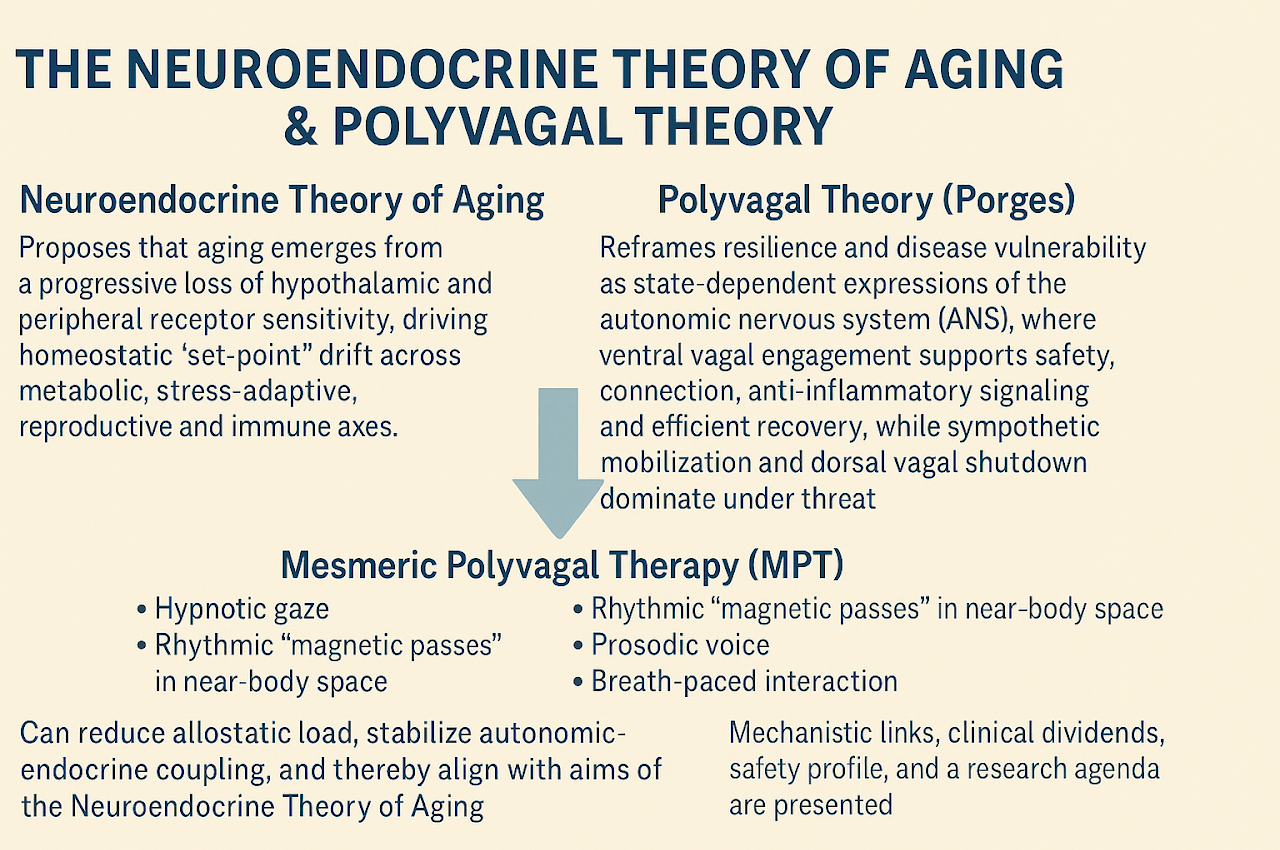
The Neuroendocrine Theory of Aging (Dilman; Dean) proposes that aging results from a progressive loss of receptor sensitivity, first in the hypothalamus and then in the periphery, which makes the homeostatic set-points drift across the metabolic, stress-adaptive, reproductive and immune axes. In parallel, Polyvagal Theory (Porges) reads resilience and vulnerability to disease as expressions of the state of the autonomic nervous system (ANS): ventral vagal engagement supports safety, connection, anti-inflammatory signaling and efficient recovery, while sympathetic mobilization and dorsal vagal shutdown prevail under threat. A non-verbal, state-first clinical approach, Mesmeric Polyvagal Therapy (MPT), based on the hypnotic gaze, rhythmic “magnetic passes” in the space close to the body, a prosodic voice and breath-paced interaction, can reduce allostatic load, stabilize the coupling between the autonomic and endocrine systems, and so serve the aims of the Neuroendocrine Theory of Aging. This page presents the mechanistic links, the clinical benefits, the safety profile and a research agenda.
1) The Neuroendocrine Theory of Aging: A Short Overview
1) The Neuroendocrine Theory of Aging: A Short Overview
According to the Neuroendocrine Theory, aging is driven less by clock-like wear and more by the breakdown of feedback between hormones, neurotransmitters and their receptors, a process that begins centrally in the hypothalamus and spreads to the periphery. Its core elements are:
Hypothalamic set-point drift. With age, inhibitory feedback becomes less effective; cortisol, insulin, gonadotropins (the hormones that regulate the reproductive glands) and inflammatory mediators are regulated around less favorable set-points.
Receptor desensitization and loss. Oxidative stress, stiffer cell membranes and glycation (AGEs, the damage caused when sugars bind to proteins) reduce the number and responsiveness of receptors, weakening the “brakes” on catabolic and pro-inflammatory cascades.
Four homeostats under strain. The energy and metabolic, stress-adaptive (HPA), reproductive and immune networks lose fine control, which increases the risk of insulin resistance, sarcopenia (loss of muscle mass), low-grade inflammation and cognitive vulnerability.
Two levers recur in the framework of Dilman and Dean: (i) re-sensitizing receptors, by protecting membranes and lowering oxidative and inflammatory noise, and (ii) conserving key neurotransmitters (for example catecholamines, such as adrenaline and dopamine) to keep central vigilance healthy rather than hypervigilant. The clinical goal is not simply to replace hormones but to restore dynamic responsivity: the capacity to rise to a challenge and then return to baseline efficiently.
2) Polyvagal Neurobiology: Why a State-First Method Matters
2) Polyvagal Neurobiology: Why a State-First Method Matters
Polyvagal Theory describes a hierarchical ANS:
Ventral vagal (myelinated fibers from the nucleus ambiguus in the brainstem): social engagement, a flexible “vagal brake,” anti-inflammatory signaling, prosody, eye contact and efficient recovery.
Sympathetic: fight-or-flight mobilization.
Dorsal vagal (unmyelinated fibers from the dorsal motor nucleus of the vagus): immobilization, from rest to shutdown.
In our clinical practice, non-verbal safety cues (a soft gaze, a warm voice, longer exhalations, a predictable rhythm close to the body) reduce the brain’s expectation of danger, quiet the rumination of the Default Mode Network (DMN) and allow tonic stillness with preserved tone: immobility without collapse, a state associated with analgesia, better cooperation and easier learning. The chapter “Hypnosis, Polyvagal Theory, and Somatic Liberation” describes these mechanisms and the signs observable in session (for example longer exhalations, a softer face), and presents hypnosis as relational regulation rather than suggestion alone.
3) Mesmeric Polyvagal Therapy (MPT): Definition, Core Process and Somatic Liberation
3) Mesmeric Polyvagal Therapy (MPT): Definition, Core Process and Somatic Liberation
MPT is a non-verbal, contact-free clinical craft that puts safety first and regulates autonomic set-points through:
Gaze (fascination), an orienting cue that, within rapport, quickly turns into blended stillness: calm immobility in which the safety system stays active.
Magnetic passes (slow, predictable hand movements in the space close to the body), which act as a visual metronome signaling “nothing sudden” and so stabilize interoception and vagal flow without touch.
A prosodic voice and longer exhalations, which recruit the ventral vagal brake, reduce the startle response and quiet DMN chatter.
Anchored dissociation: pain and intrusive stimuli move to the periphery of awareness, while orientation and choice remain intact.
Somatic Liberation (SL): a non-verbal discharge sequence, protected by safety, through which incomplete defensive motor programs can complete under ventral anchoring. The typical arc: orienting alert → blended stillness (catalepsy anchored in the ventral state, that is a spontaneous holding of posture) → micro-mobilizations (tremor, a tiny push, pull, reach or step, a brief vocalization) → oscillation and completion → natural resolution and re-engagement. SL is not catharsis: it emerges once DMN preoccupation has softened and interoception is stable; agency and orientation are preserved.
4) The Mechanistic Link: From Ventral Vagal Engagement to Neuroendocrine Resilience
4) The Mechanistic Link: From Ventral Vagal Engagement to Neuroendocrine Resilience
The non-verbal grammar of MPT corresponds to several pathways that the Neuroendocrine Theory of Aging seeks to protect:
Lowering the HPA axis and relieving allostatic load. Ventral vagal activation signals safety, lets the vagal brake engage and reduces sustained sympathetic drive. This favors shorter cortisol peaks, less release of catecholamines and a faster return to baseline, directly countering the set-point drift typical of aging under chronic stress. Ventral engagement goes with steadier breathing, a reduced startle response and better blood pressure readings: clinical signs of a lower allostatic load.
Anti-inflammatory reflex and immune–endocrine dialogue. The vagus nerve modulates the production of cytokines, the messengers of inflammation (the cholinergic anti-inflammatory reflex). Calm ventral states, such as cataleptic stillness with tone and prosodic connection, open the physiological window for repair, consistent with the reduced amplification of pain and the better tolerance of medical procedures we observe. Over time this reduces the burden of inflammaging, the chronic low-grade inflammation of aging that erodes receptor sensitivity.
Interoception and a quieter DMN → efficient top-down control. By dampening the DMN (less self-referential chatter) and stabilizing interoception (a clearer “body map”), MPT allows a more precise recruitment of the descending pain-modulation systems (PAG–RVM–dorsal horn, the pathway from the brainstem to the spinal cord) and prefrontal oversight of limbic alarm. Both are key to preserving the signal-to-noise ratio in aging neuroendocrine circuits.
Co-activation without collapse. In co-activation organized by the ventral state, the system can mobilize briefly and land smoothly, avoiding the brittle overdrive → crash sequence that accelerates endocrine wear. Clinically, MPT uses short, dosed mobilizations inside a ventral framework and then returns to stillness: exactly the flexibility the Neuroendocrine Theory aims to restore.
Somatic Liberation as “completion physiology.” By allowing stuck defensive programs (a tiny push, pull, reach or tremor) to complete safely, anchored in the ventral state, and then letting the person re-engage, SL reduces the tonic coupling of sympathetic and dorsal states, resets predictive coding (the brain’s expectations) around interoception and shortens recovery time after a challenge. These mechanisms lower allostatic load and protect receptor responsiveness over time.
5) Clinical Benefits of MPT (Evidence Summarized in the Chapter)
5) Clinical Benefits of MPT (Evidence Summarized in the Chapter)
Analgesia without disorientation. MPT produces analgesia anchored in the ventral state, which reduces nociceptive gain (the amplification of pain signals) while preserving agency, and which differs from dorsal numbing. This agrees with meta-analytic findings on hypnotic analgesia and explains why the effects can be rapid and lasting when safety is explicit. Stabilization around medical procedures. Short, contact-free sequences (soft gaze, about 4–6 breaths per minute, a steady rhythm close to the body) reduce white-coat surges in blood pressure, make cannulation easier and improve cooperation, turning autonomic coherence into practical gains in the clinical setting.
Support in stress and burnout. By restoring the ventral “service brake,” MPT helps hyperergic patients (“wired and tired”) slow down without collapsing and hypoergic patients, low in energy, mobilize again without alarm. This shortens the long arc from overdrive to shutdown described in the sections on stress and burnout.
Functional somatic symptoms (for example gut–brain). Safe interoception together with ventral engagement reduces defensive prediction in presentations similar to irritable bowel syndrome (IBS), settling cramps long enough to allow examination or teaching.
Somatic Liberation of entrenched patterns. In “stuck” physiology shaped by trauma, SL leads from shutdown → caring immobility with tone → brief, buffered mobilization → re-engagement, with consistent signs in session (sighs, tremors, a reset of breathing, the return of social gaze) and patient reports (“I can breathe again,” “my shoulders feel heavy but soft”).
Application to groups. Brief shared silence, synchronized breathing and a predictable rhythm extend co-regulation to the whole group and reduce friction for everyone.
6) How MPT Aligns with “Receptor Recovery” Aims in Aging
6) How MPT Aligns with “Receptor Recovery” Aims in Aging
Although receptor pharmacology lies outside the direct scope of MPT, state regulation, including Somatic Liberation, shapes the internal environment in which receptors operate:
Less oxidative and inflammatory noise → less post-translational damage to receptors and membranes.
Shorter, better-timed hormone pulses → less desensitization and down-regulation of receptors.
Deeper sleep and better pain control → more effective glymphatic and immune housekeeping (the brain’s nightly waste clearance), which indirectly supports the health of synapses and receptors.
In short, MPT and SL do not replace biochemical strategies: they make them possible, by lowering allostatic friction and restoring autonomic–endocrine precision, the very quality the Neuroendocrine Theory considers lost with age.
Learn the method
Mesmeric Polyvagal Therapy is taught in the courses of Dr. Paret's School (ISI-CNV – Université Européenne): live seminars and online lessons, from the first-level Master to advanced training, with specific expertise in polyvagal hypnosis, trembling, completion of the response and ventral vagal stimulation. Request the programme and the next dates: our first contact is always a WhatsApp message, never a call.
→ Request information on the courses
→ Videos and international activity of Dr. Paret
→ marcoparet.com: the School of Dr. Paret
This site is available in: English · Italiano · Français · Русский · 中文
Research notes
A selection of peer-reviewed studies on polyvagal theory and vagal function that offer a scientific reading of the topics discussed in this article.
Sapolsky RM, Krey LC, McEwen BS (1986). The neuroendocrinology of stress and aging: the glucocorticoid cascade hypothesis. Endocrine Reviews, 7(3), 284-301. A classic review formulating the 'glucocorticoid cascade hypothesis', in which prolonged glucocorticoid exposure affects the hippocampus and weakens feedback control of the stress response over time; it is a reference point for neuroendocrine theories of ageing. https://doi.org/10.1210/edrv-7-3-284
Thayer JF, Sternberg E (2006). Beyond heart rate variability: vagal regulation of allostatic systems. Annals of the New York Academy of Sciences, 1088, 361-372. This review reports that lower vagal function and HRV are associated with higher fasting glucose, higher overnight urinary cortisol and more pro-inflammatory markers, suggesting an inhibitory role of vagal activity on allostatic systems including the HPA axis. https://doi.org/10.1196/annals.1366.014
Tracey KJ (2002). The inflammatory reflex. Nature, 420(6917), 853-859. Tracey describes how cholinergic, vagus-mediated signalling inhibits inflammation reflexively, much as the nervous system regulates heart rate; this 'inflammatory reflex' links vagal activity with the low-grade inflammation associated with ageing. https://doi.org/10.1038/nature01321
Umetani K, Singer DH, et al. (1998). Twenty-four hour time domain heart rate variability and heart rate: relations to age and gender over nine decades. Journal of the American College of Cardiology, 31(3), 593-601. In 260 healthy people aged 10 to 99, HRV declined with age, with the vagally related indices rMSSD and pNN50 falling most rapidly up to the sixth decade; it documents the age-related decline of autonomic flexibility. https://doi.org/10.1016/s0735-1097(97)00554-8
Page updated
Google Sites
Report abuse
This site uses cookies from Google to deliver its services and to analyze traffic. Information about your use of this site is shared with Google. By using this site, you agree to its use of cookies.
Learn more
Got it