Embedded Files
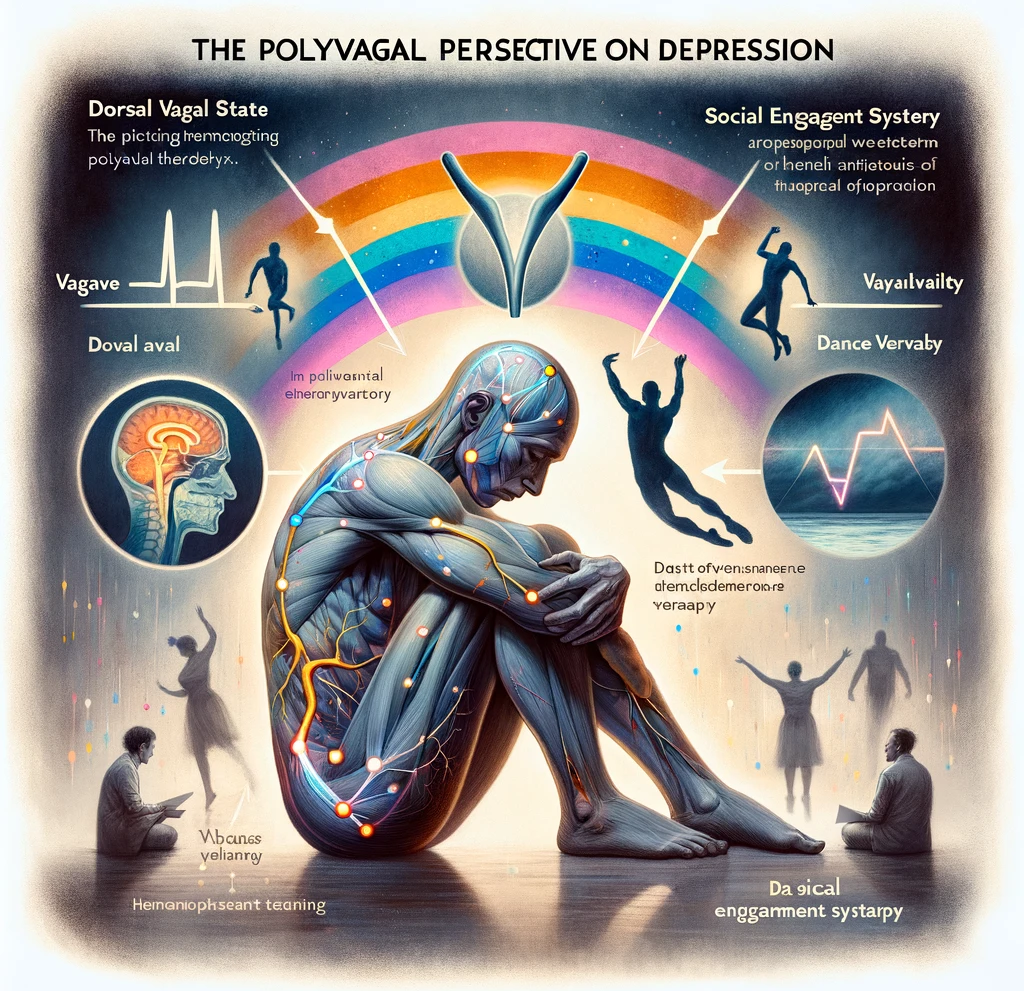
Addressing Depression with Non-Verbal Hypnosis and Polyvagal Therapy
Addressing Depression with Non-Verbal Hypnosis and Polyvagal Therapy
From the viewpoint of polyvagal therapy, depression is more than a set of psychological symptoms as listed in the DSM-5 of the American Psychiatric Association (2013). It is also a physical state closely tied to the nervous system, as polyvagal theory shows by emphasising the role of the vagus nerve in managing emotions.
Depression in the light of polyvagal theory
Depression and the dorsal vagal state:
Schwerdtfeger & Friedrich-Mai (2009) noted that typical symptoms of depression, such as fatigue and social withdrawal, match a 'dorsal vagal state'. In this state the dorsal branch of the vagus nerve, which governs shutdown and conservation of energy, prevails, and the body's capacity for active, social relaxation is reduced.
Depression as social disengagement:
In his PESI seminar (2011), Dr. Porges suggests that the core of depressive symptoms, reduced movement and reduced emotional expression, is better understood as a withdrawal from social engagement and a sign of diminished vagal tone. This challenges traditional views of depression.
Social interaction and heart rate variability (HRV):
Schwerdtfeger et al. (2009) found that people with depression showed higher vagal tone, and therefore better social interaction, only in the presence of close relationships. Safe interactions built on trust are therefore important for strengthening cardiac vagal tone. In depression, the connections between the Default Mode Network (DMN, the brain network active when the mind turns inward) and the areas of emotion and motivation weaken. The DMN, central to self-reflection and daydreaming, becomes overactive and leads to rumination, the repetitive circling of negative thoughts. Polyvagal theory suggests strengthening frontal vagal tone to counteract this overactivity, which promotes relaxation and positive social interaction and can reduce rumination and depressive symptoms.
The role of dance and movement:
Devereaux (2017a) and Karkou et al. (2019) show that dance/movement therapy is consistent with polyvagal theory because it builds a safe, empathic space. In this space people can gradually re-engage their bodies and emotions, which supports recovery from depressive states.
Non-verbal communication:
According to Karkou et al. (2019), dance/movement therapy is particularly effective because it facilitates non-verbal expression, which helps people with depression reconnect physical sensations, emotions and thoughts.
Polyvagal theory thus changes our understanding of depression: from a purely mental or emotional condition to a state with physiological changes, especially in social engagement and vagal tone. Approaches such as dance/movement therapy, which offer a safe, understanding environment and help the person reconnect with the social engagement system, prove beneficial in overcoming depression. They aim to restore physical and emotional integration and a sense of connection with others.
Mesmeric Polyvagal Therapy with Magnetic Passes (Felt Sense) and the Crisis
Mesmeric Polyvagal Therapy with Magnetic Passes (Felt Sense) and the Crisis
Depression is characterised by an activation of the dorsal vagus that holds the body still, as in a state of chronic tiredness. As Porges noted, it is better understood as a withdrawal from social engagement and a sign of diminished vagal tone.
A possible protocol for depression uses magnetic passes, slow movements of the hands along the body, to activate the ventral vagus, the branch linked to safety and social connection, through body awareness. We saw people emerge from this heaviness under magnetic passes long before polyvagal theory could tell us what happens in their nervous system.
Finally, the mesmeric polyvagal crisis, a spontaneous release of the nervous system through trembling, tears or deep breaths, can unblock specific memories and help the client change attitude.
Learn the method
Mesmeric Polyvagal Therapy is taught in the courses of Dr. Paret's School (ISI-CNV – Université Européenne): live seminars and online lessons, from the first-level Master to advanced training, with specific expertise in polyvagal hypnosis, trembling, completion of the response and ventral vagal stimulation. Request the programme and the next dates: our first contact is always a WhatsApp message, never a call.
→ Request information on the courses
→ Videos and international activity of Dr. Paret
→ marcoparet.com: the School of Dr. Paret
This site is available in: English · Italiano · Français · Русский · 中文
Research notes
A selection of peer-reviewed studies on polyvagal theory and vagal function that offer a scientific reading of the topics discussed in this article.
Kemp AH, Quintana DS, et al. (2010). Impact of depression and antidepressant treatment on heart rate variability: a review and meta-analysis. Biological Psychiatry, 67(11), 1067-1074. In a meta-analysis of 18 studies, people with major depression without cardiovascular disease showed lower HRV than controls, with lower HRV at greater severity; several antidepressants did not restore HRV despite symptom improvement. https://doi.org/10.1016/j.biopsych.2009.12.012
Koenig J, Kemp AH, et al. (2016). Depression and resting state heart rate variability in children and adolescents: a systematic review and meta-analysis. Clinical Psychology Review, 46, 136-150. This meta-analysis found lower resting high-frequency HRV in clinically depressed children and adolescents than in healthy peers, consistent with adult findings, although no correlation with symptom severity emerged in non-clinical samples. https://doi.org/10.1016/j.cpr.2016.04.013
Chen X, Yang R, et al. (2017). Hypnosis in the treatment of major depression: an analysis of heart rate variability. International Journal of Clinical and Experimental Hypnosis, 65(1), 52-63. In a small study of 21 patients with major depression, HRV parameters increased during and after hypnosis compared with the pre-hypnotic condition; the sample is small and uncontrolled, so the finding is preliminary. https://doi.org/10.1080/00207144.2017.1246873
Breit S, Kupferberg A, et al. (2018). Vagus nerve as modulator of the brain-gut axis in psychiatric and inflammatory disorders. Frontiers in Psychiatry, 9, 44. This review notes preliminary evidence that interventions targeting the vagus nerve, including vagus nerve stimulation and breathing-based practices, may support people with treatment-resistant depression, partly through effects on vagal tone and inflammation. https://doi.org/10.3389/fpsyt.2018.00044
Page updated
Google Sites
Report abuse
This site uses cookies from Google to deliver its services and to analyze traffic. Information about your use of this site is shared with Google. By using this site, you agree to its use of cookies.
Learn more
Got it