Embedded Files
The Mitochondrial Theory of Aging and Mesmeric Polyvagal Therapy: Linking Bioenergetics and Somatic Renewal
The Mitochondrial Theory of Aging and Mesmeric Polyvagal Therapy: Linking Bioenergetics and Somatic Renewal
1. The Mitochondrial Basis of Aging
1. The Mitochondrial Basis of Aging
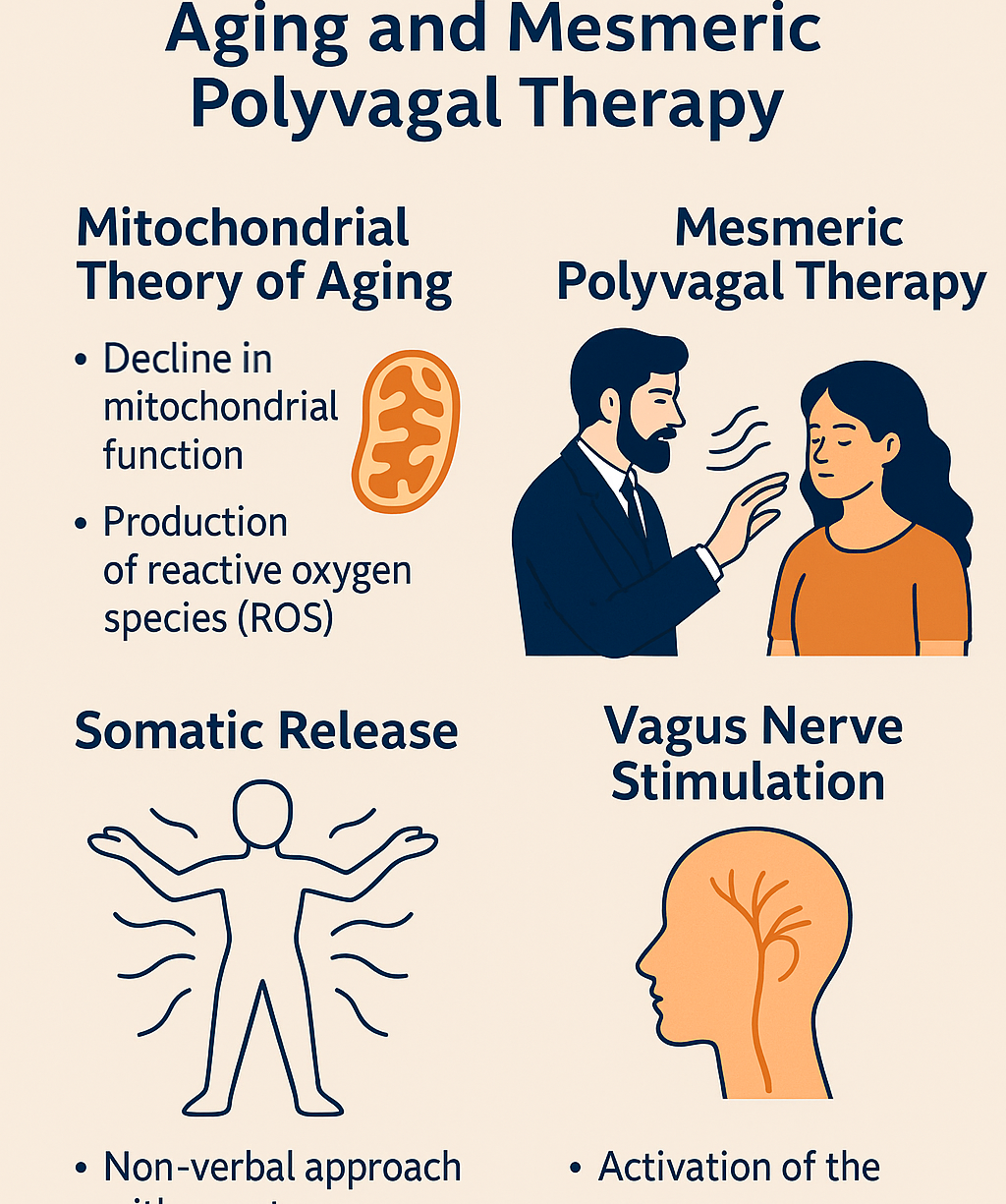
The mitochondrial theory of aging, first proposed by Denham Harman in the mid-20th century, remains one of the most influential models for understanding biological decline. It holds that aging arises mainly from the progressive dysfunction of mitochondria, the structures inside our cells that produce energy in the form of ATP through oxidative phosphorylation (the use of oxygen to release energy from nutrients).
Over time, reactive oxygen species (ROS), unstable molecules produced by mitochondrial respiration, accumulate and damage DNA, proteins and lipids. This creates a self-perpetuating cycle of energy inefficiency and oxidative stress. As mitochondria lose their capacity to regulate energy and redox balance, the cell becomes less resilient, which leads to chronic inflammation, impaired repair and, in the end, aging of the whole organism.
Recent studies confirm that mitochondrial dynamics, the balance between fission (division) and fusion of mitochondria, are closely linked to longevity, and that interventions which stabilize mitochondrial function, such as caloric restriction, NAD⁺ restoration or mild hormesis (small, beneficial doses of stress), can extend lifespan across species.
2. From Energy Production to Bio-Consciousness (a Parallel with Ancient Traditions)
2. From Energy Production to Bio-Consciousness (a Parallel with Ancient Traditions)
The same ideas appear in traditional Taoist physiology. There, Jing (essence) is the body’s congenital vitality, the reserve of life potential inherited at birth, while Qi is the current that transforms this reserve and circulates through the organism as warmth, movement and consciousness.
From this perspective, mitochondrial decline corresponds to the loss of the body’s capacity to convert Jing into Qi: the inner “furnace” no longer turns potential energy into living flow. The Taoist practitioner seeks to “refine essence into energy and energy into spirit” (Lian Jing Hua Qi, Lian Qi Hua Shen), a process that closely parallels mitochondrial rejuvenation and bioenergetic optimization at the cellular level.
Longevity then means more than avoiding decay: it is the art of maintaining energetic coherence, a continuous transformation of stored essence into conscious vitality.
3. The Polyvagal Axis: Regulating the Inner Environment
3. The Polyvagal Axis: Regulating the Inner Environment
Polyvagal Theory (Porges, 1995) describes the autonomic nervous system (ANS), the part of the nervous system that works without conscious control, as a hierarchy organized around safety and connection. Its ventral vagal branch supports calm states, social engagement and efficient homeostatic regulation, including the anti-inflammatory signalling of the “cholinergic anti-inflammatory pathway”, through which the vagus nerve dampens inflammation.
When ventral vagal tone is strong, the body stays flexible, oxygenation is optimal and mitochondrial efficiency improves, because stress hormones and sympathetic dominance no longer overload the metabolic pathways. Conversely, chronic dorsal vagal shutdown (a state of collapse and disconnection driven by the oldest branch of the vagus nerve) or sympathetic overdrive (constant alarm) suppresses mitochondrial biogenesis, reduces ATP output and fosters systemic inflammation: the modern physiological equivalent of “Qi stagnation”.
4. Mesmeric Polyvagal Therapy and Somatic Release
4. Mesmeric Polyvagal Therapy and Somatic Release
Mesmeric Polyvagal Therapy (MPT), developed by Dr. Marco Paret, is an original, non-verbal approach that integrates the tradition of animal magnetism with modern neurophysiology. Through the hypnotic gaze, rhythmic magnetic passes made close to the body, and synchronized breath and gesture, MPT creates a non-verbal dialogue with the unconscious and with the autonomic body, stimulating the person’s own inner force.
The process induces somatic release, a spontaneous discharge of chronic tension patterns, and so restores the body’s natural rhythm of contraction and expansion. As the system returns to ventral vagal regulation, the person feels warmth and pulsation, and spontaneous micro-movements appear that often correspond to the re-opening of the vagal–respiratory loop. These releases were familiar to us from our practice long before we connected them with the vagus nerve; the theory now offers a hypothesis about why they occur.
This state of relaxed coherence supports:
Improved mitochondrial oxygen use (through the vagal influence on breathing and cardiac output),
Reduced ROS production (through parasympathetic dominance),
Enhanced autophagy and cellular repair (autophagy is the cell’s recycling of damaged components), and
Reconnection between body awareness and self-presence, the psychosomatic core of vitality.
5. Vagus Nerve Stimulation and Bioenergetic Resonance
5. Vagus Nerve Stimulation and Bioenergetic Resonance
Research on vagus nerve stimulation (VNS) shows that mild activation of the vagus, whether electrical or through breath, voice, gaze or touch, can:
Increase mitochondrial biogenesis via PGC-1α pathways,
Reduce systemic inflammation through acetylcholine-mediated cytokine inhibition (the vagal neurotransmitter slows the release of inflammatory messengers), and
Enhance neuroplasticity and mood regulation.
MPT achieves a comparable modulation non-invasively. The rhythmic passes and the practitioner’s mesmeric presence act as resonant signals that entrain the person’s autonomic rhythms, much as oscillating electromagnetic fields can synchronize cellular activity. In this sense the mesmeric field becomes a bio-coherent environment in which mitochondria and vagus nerve return to functional harmony.
6. Toward a Unified Model of Longevity and Transformation
6. Toward a Unified Model of Longevity and Transformation
A recent body of research proposes a “unifying theory” linking modern biomedicine and traditional Chinese medicine: aging can be seen as the dual decline of mitochondrial function and congenital Qi. Mesmeric Polyvagal Therapy offers a practical bridge between these perspectives, working at the same time as:
A physiological intervention, restoring vagal–mitochondrial coupling and reducing allostatic load (the cumulative wear caused by chronic stress);
A somatic-energetic art, refining the flow of Qi and harmonizing the body’s internal currents;
A practice of consciousness, guiding awareness beyond verbal control towards direct participation in the life force itself.
Where modern gerontology seeks cellular rejuvenation, MPT seeks vital coherence: a living state in which mitochondria, nerves and consciousness work in unison.
7. Conclusion
7. Conclusion
The mitochondrial theory of aging and the Mesmeric Polyvagal approach converge on one insight: longevity depends not only on molecular repair but on restoring rhythmic coherence at every level of the person. From the Taoist alchemist who refines essence into energy to the Mesmeric practitioner who awakens the body’s non-verbal intelligence, the principle is the same: renewal arises from resonance.
Learn the method
Mesmeric Polyvagal Therapy is taught in the courses of Dr. Paret's School (ISI-CNV – Université Européenne): live seminars and online lessons, from the first-level Master to advanced training, with specific expertise in polyvagal hypnosis, trembling, completion of the response and ventral vagal stimulation. Request the programme and the next dates: our first contact is always a WhatsApp message, never a call.
→ Request information on the courses
→ Videos and international activity of Dr. Paret
→ marcoparet.com: the School of Dr. Paret
This site is available in: English · Italiano · Français · Русский · 中文
Research notes
A selection of peer-reviewed studies on polyvagal theory and vagal function that offer a scientific reading of the topics discussed in this article.
Picard M, Juster RP, McEwen BS (2014). Mitochondrial allostatic load puts the 'gluc' back in glucocorticoids. Nature Reviews Endocrinology, 10(5), 303-310. This perspective proposes that chronic stress, through glucocorticoids and elevated glucose, damages mitochondria and mitochondrial DNA, promoting inflammation and faster cellular ageing; it connects stress physiology with mitochondrial theories of ageing. https://doi.org/10.1038/nrendo.2014.22
Picard M, McEwen BS (2018). Psychological stress and mitochondria: a systematic review. Psychosomatic Medicine, 80(2), 141-153. A systematic review of 23 experimental studies, all in male animals, found that acute and chronic stressors mostly had adverse effects on mitochondrial function; the authors note that human evidence is still limited and largely observational. https://doi.org/10.1097/PSY.0000000000000545
Franceschi C, Garagnani P, et al. (2018). Inflammaging: a new immune-metabolic viewpoint for age-related diseases. Nature Reviews Endocrinology, 14(10), 576-590. The authors describe 'inflammaging', a chronic low-grade inflammation that develops with age and contributes to age-related diseases, and discuss the role of metabolism and gut microbiota in sustaining it. https://doi.org/10.1038/s41574-018-0059-4
Umetani K, Singer DH, et al. (1998). Twenty-four hour time domain heart rate variability and heart rate: relations to age and gender over nine decades. Journal of the American College of Cardiology, 31(3), 593-601. In 260 healthy people aged 10 to 99, HRV declined with age, with the vagally related indices rMSSD and pNN50 falling most rapidly up to the sixth decade; it documents the age-related decline of autonomic flexibility. https://doi.org/10.1016/s0735-1097(97)00554-8
Page updated
Google Sites
Report abuse
This site uses cookies from Google to deliver its services and to analyze traffic. Information about your use of this site is shared with Google. By using this site, you agree to its use of cookies.
Learn more
Got it